Baskin-Robbins History (2026): From 1945’s 31 Flavors to 7,800+ Shops
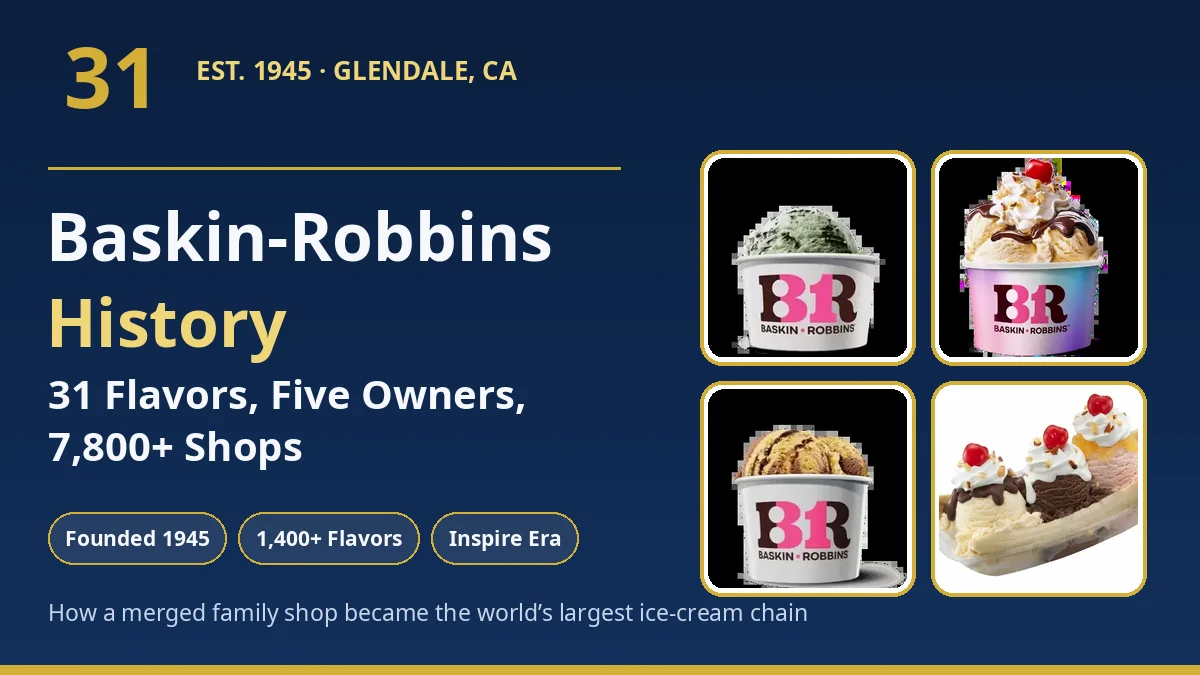
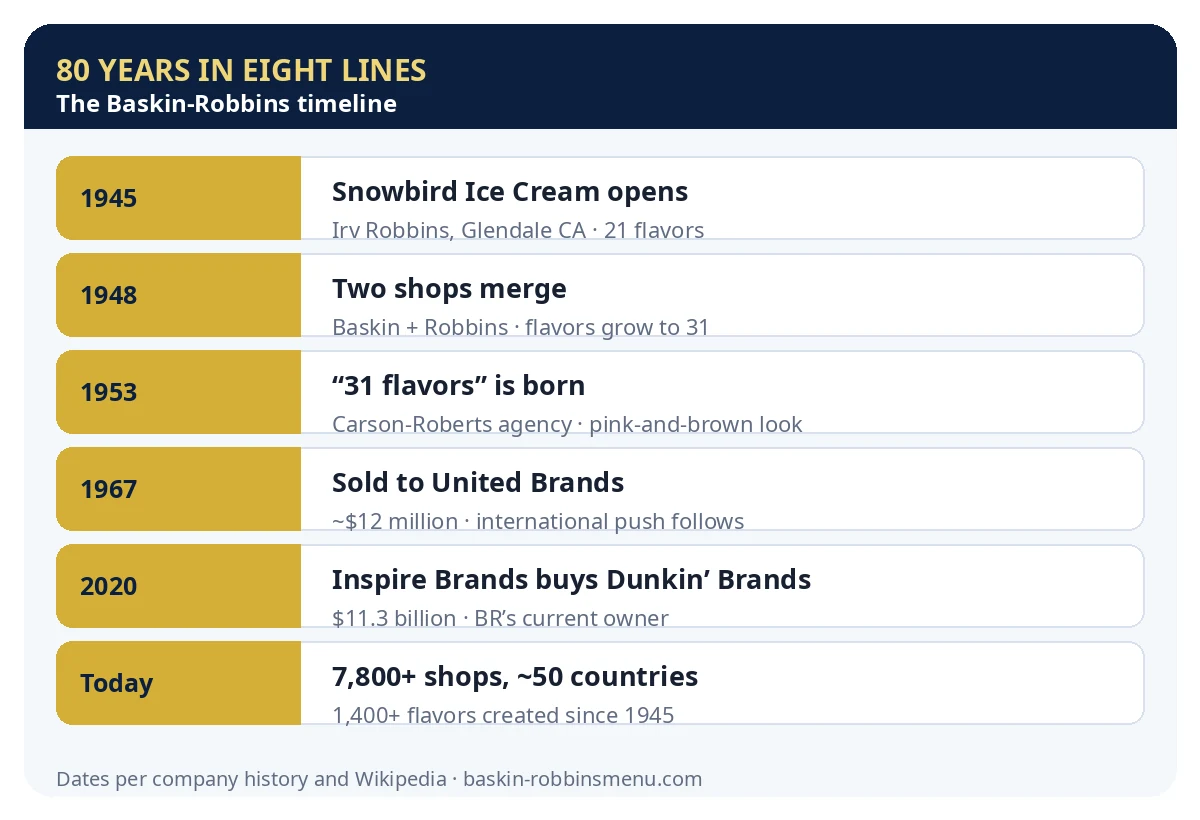
Baskin-Robbins begins with two brothers-in-law who each thought the other was underselling ice cream. Irv Robbins opened Snowbird Ice Cream in Glendale, California in 1945 — already radical for offering 21 flavors — and in 1946 his brother-in-law Burt Baskin opened Burton’s Ice Cream in Pasadena with the same more-flavors philosophy. In 1948 they merged, pooled their recipes, and the combined menu reached the number that would define the company: 31 flavors, one for every day of the month. Eighty years, five owners and more than 1,400 flavors later, it is the largest ice-cream specialty chain on earth.
The ideas that built it
Three decisions made the chain. Franchising, early: Baskin and Robbins were among the first food operators to franchise aggressively — by the mid-1950s hundreds of shops carried the name, which is why the brand spread faster than any rival and why, to this day, your local shop is an independent business (the reason prices and hours vary across this whole site). The 1953 rebrand: the Carson-Roberts advertising agency unified the shops under one name and the “31 flavors” idea, wrapped in the pink-and-brown polka-dot look; the famous pink tasting spoon followed, turning sampling into ritual. The flavor library: the company has introduced more than 1,400 flavors since 1945 — the rotating case and the Flavor of the Month are not marketing garnishes, they are the founding idea, industrialized. Even the logo hides it: the “31” sits inside the BR initials.
Five owners, one sign
The founders ran it until 1967, when United Brands (the former United Fruit Company) bought the chain for an estimated $12 million, just before Burt Baskin’s death. The 1970s took it public briefly, then global — Japan, Saudi Arabia, Korea, Australia — and in 1973 Britain’s J. Lyons & Co. took it private again. Through mergers it landed with Allied Domecq, which paired it with Dunkin’ Donuts; that pairing became Dunkin’ Brands, and in December 2020 Inspire Brands bought Dunkin’ Brands for $11.3 billion — the deal that makes Baskin-Robbins today a sibling of Arby’s, Sonic and Jimmy John’s, headquartered with Dunkin’ in Canton, Massachusetts. The count today: more than 7,800 shops in roughly 50 countries, about 2,400–2,500 of them in the US. Through every sale, the pink sign and the number 31 survived — the most durable assets in the building.
Baskin-Robbins history — frequently asked questions
When was Baskin-Robbins founded?
1945, when Irv Robbins opened Snowbird Ice Cream in Glendale, California. Burt Baskin’s Burton’s shop followed in 1946, and the two merged in 1948 to form Baskin-Robbins.
Why 31 flavors?
One flavor for every day of the longest month. The merged shops’ combined menu reached 31, and in 1953 the Carson-Roberts agency turned it into the slogan and brand identity. The current case still holds 31+ flavors, from a library of more than 1,400 created since 1945.
Who owns Baskin-Robbins now?
Inspire Brands, which acquired Dunkin’ Brands — Baskin-Robbins’ parent since the Allied Domecq era — in December 2020 for $11.3 billion. Previous owners: the founders (to 1967), United Brands, J. Lyons & Co., and Allied Domecq / Dunkin’ Brands.
How many Baskin-Robbins are there?
More than 7,800 shops in roughly 50 countries (2024 figures), making it the world’s largest ice-cream specialty chain. About 2,400–2,500 are in the United States; the majority of the system is now international.
Where was the first Baskin-Robbins?
Glendale, California — Irv Robbins’ Snowbird Ice Cream (1945). The first shops under the merged Baskin-Robbins name followed the 1948 merger in Southern California, and franchising spread the format nationwide in the 1950s.