Baskin-Robbins Franchise Cost (2026): $307K–$627K, Fees & Requirements From the FDD
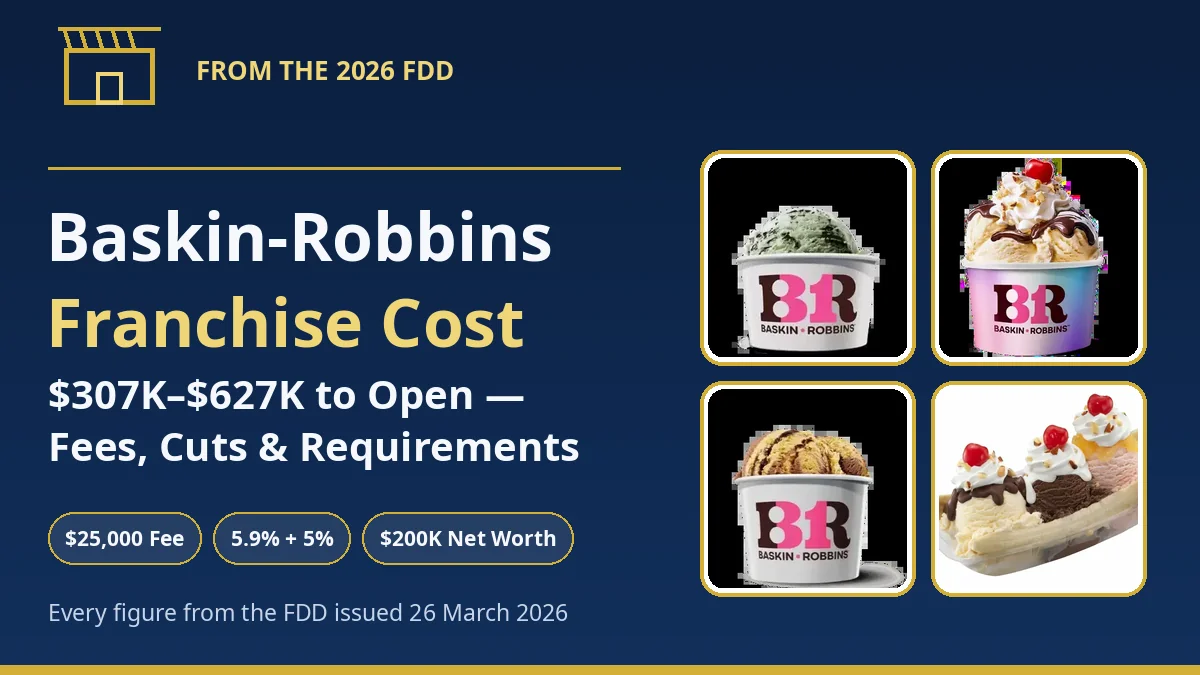
Every figure on this page comes from the franchisor’s own documents — the Baskin-Robbins Franchise Disclosure Document (FDD) issued 26 March 2026 and Inspire Brands’ official franchising pages — not from franchise-resale blogs, whose numbers are routinely a decade old. The headline: opening a traditional Baskin-Robbins shop costs an estimated $307,400 to $626,700 all-in, and the brand takes 10.9% of gross sales off the top, forever. Here is the full breakdown and what actually moves a store toward the top of that range.
Checked: 7 November 2026. This page summarizes public franchise documents; it is not financial advice, and the FDD itself — which a franchisor must give you at least 14 days before you sign or pay anything — is the document to make decisions from.
Where the money goes
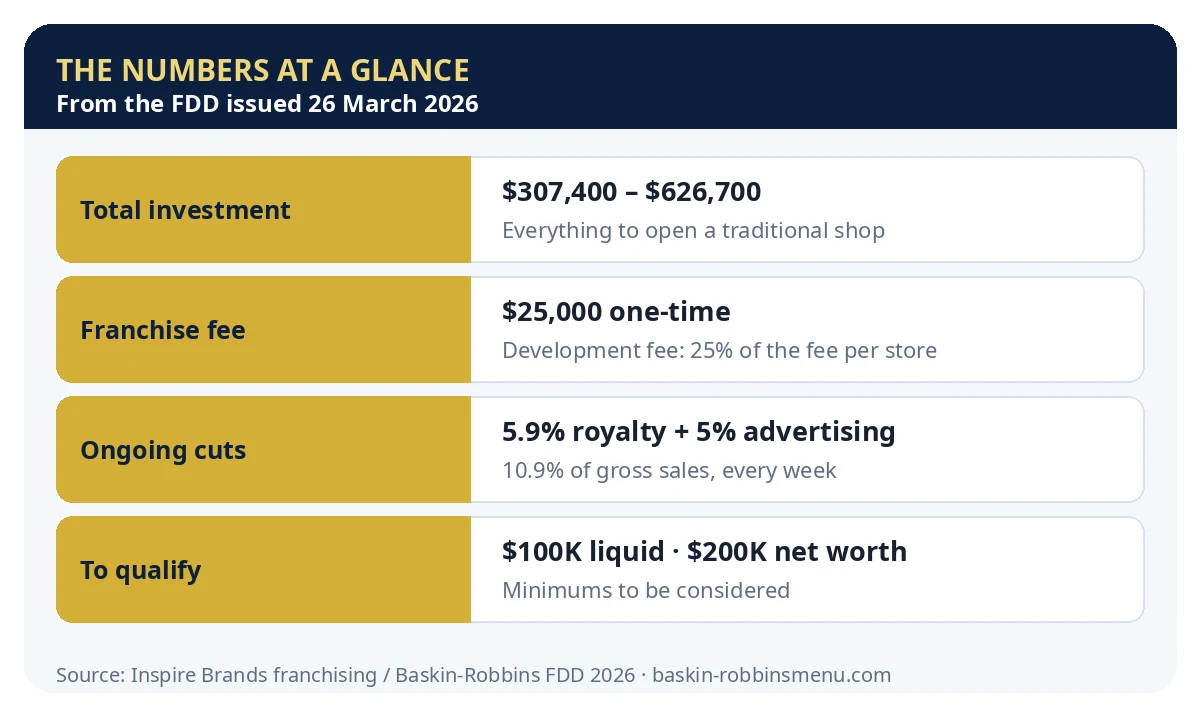
| Item | Figure (2026 FDD) |
|---|---|
| Initial franchise fee | $25,000 |
| Development fee (multi-store) | 25% of the franchise fee, per store |
| Total initial investment | $307,400 – $626,700 |
| Royalty | 5.9% of gross sales |
| Advertising fund | 5% of gross sales |
| To qualify | $100,000 liquid assets · $200,000 net worth |
The spread between $307K and $627K is mostly real estate and format: a conversion or small-footprint shop in a cheap market sits low; a new build — and above all a Dunkin’/Baskin-Robbins combo, the format the brand pushes hardest — sits high, because you are building two counters, two equipment packages and often a drive-thru (the drive-thru guide explains why combos dominate new builds). What the FDD’s Item 19 reports on the other side of the ledger: average unit volume of roughly $503,000 a year in sales. Read that correctly — it is gross sales, not profit, and from it come the 10.9% brand cut, rent, labor, and the most seasonal cost curve in fast food. Ice cream earns its year in about five months; the FDD range quietly assumes you can fund the other seven.
The questions the brochure does not answer
Three things separate a serious candidate from a brochure reader. Seasonality: a scoop shop in Minnesota and one in Florida are different businesses wearing the same sign; ask existing franchisees in your climate what winter actually looks like. The combo question: pairing with Dunkin’ roughly doubles the build cost but buys morning dayparts and a drive-thru — most new US development is combo for a reason, and the reason is the calendar, not the coffee. Canada: franchising runs there too (113 Canadian shops, most franchised), under a Canadian disclosure document with its own financial terms — the US figures on this page do not transfer across the border. In all cases the process is the same: qualify against the liquid/net-worth minimums, receive the FDD, and use the 14-day window to call current franchisees — the FDD lists them.
Baskin-Robbins franchise — frequently asked questions
How much does a Baskin-Robbins franchise cost?
Per the FDD issued 26 March 2026, the total initial investment for a traditional shop is $307,400 to $626,700, including the $25,000 initial franchise fee. Where a store lands in the range depends on format (standalone vs Dunkin’ combo), new build vs conversion, and local construction costs.
What are Baskin-Robbins’ royalty and advertising fees?
Royalty is 5.9% of gross sales and the advertising fund takes 5% — a combined 10.9% of gross sales, ongoing, per the 2026 FDD.
What net worth do you need for a Baskin-Robbins franchise?
Inspire Brands’ franchising pages set the qualification floor at $100,000 in liquid assets and $200,000 in net worth. Older third-party articles cite higher figures from older FDDs — the franchisor’s current page is the one to trust.
How much does a Baskin-Robbins owner make?
The FDD reports average unit volume of roughly $503,000 in annual sales — that is gross sales, not owner profit. Profit depends on rent, labor, seasonality and the 10.9% brand cut; the FDD does not promise earnings, and any site quoting a salary figure is inventing it.
Can I open a Baskin-Robbins without a Dunkin’?
Yes — standalone shops remain part of the system, and the investment range’s low end reflects them. But most new US development is the combo format, because Dunkin’’s morning business balances ice cream’s evening-and-summer curve.